I have certain lessons that fall under the category of "History Mysteries." I like them because I can honestly tell my students that there is no right answer and it is up to them to determine what they believe and support it with evidence.
One of the mysteries that I have turned into a two day lesson is on Sacco & Vanzetti. The information for this lesson came from UMKC School of Law Famous Trials page. I took information from many of the pages and turned it into a case for my students to solve.
First students enter my classroom and see caution tape, a chalk outline of a body and evidence markers. Next I show them a video I made in the style of Law & Order. I call it Law & Order: History Revisited. Once introduced to the case, I pass out "FBI Folders" that I made. These include biographies on individuals associated with the case, maps, evidence, information on the investigation and more.
Over the course of two days, my students work as a team to find evidence to determine whether Sacco and Vanzetti were in fact guilty or not guilty. Then they have a discussion and ultimately render a verdict.
Another mystery involves the sinking of the USS Maine. Students discuss all the theories of what happened. This year I acquired, at a library auction, a textbook on the history of Cuba that was published in 1898. I cannot wait to use the last chapter on the USS Maine as a primary source.
I enjoy turning lessons into mysteries for students to solve, rather than a lecture or a reading. My students respond well to these lessons and are using collaboration, communication and critical thinking.
Saturday, October 28, 2017

Monday, July 24, 2017
Breakout EDU - The Coolest Thing Since Escape Rooms
A little over a year ago I discovered Breakout Edu. It takes the escape room concept and brings it into the classroom. Students are introduced to a locked box with a story related to the theme of the game. Together they must work collaboratively to solve puzzles, riddles and other activities. These clues then help them to open locks. With just 45 minutes to complete a game, participants are challenged to problem solve, learn perseverance and work as a team. Breakout games are designed by teachers for use with students from preschool to college, and even adults!
I use the games in my class for both review at the end of a unit and for content. For example, this past year, I used a Breakout game to teach my students about Watergate. I had limited time to cover the topic and found that rather than a lecture or worksheet (which I almost never do in my classroom anyway), I would find an engaging way to help them learn about the scandal.
I typically break students into four groups (I have 4 complete kits) to ensure there is a role for every student. I have an average of 34 students per class. Some games are completely physical games (with all clues in class). Others include online puzzles. I continue to refine and learn what works and doesn't work.
I have found that many of my students who may not do well on tests or on other assignments, excel in Breakout games. I had one student last year who was often in a group that failed to breakout. She was frustrated but refused to give up. Learning as we played each game, she came in the day of the Watergate Breakout and was determined. This time she and her group were not only the first to finish in her class, but out of all of my classes. The pride she and her team had was so cool to see.
I encourage you to give it a try! Your students will love it! Check out Breakout Edu to get started.

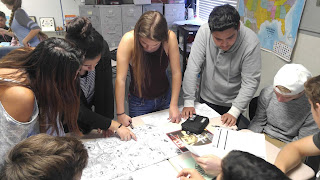

I use the games in my class for both review at the end of a unit and for content. For example, this past year, I used a Breakout game to teach my students about Watergate. I had limited time to cover the topic and found that rather than a lecture or worksheet (which I almost never do in my classroom anyway), I would find an engaging way to help them learn about the scandal.
I typically break students into four groups (I have 4 complete kits) to ensure there is a role for every student. I have an average of 34 students per class. Some games are completely physical games (with all clues in class). Others include online puzzles. I continue to refine and learn what works and doesn't work.
I have found that many of my students who may not do well on tests or on other assignments, excel in Breakout games. I had one student last year who was often in a group that failed to breakout. She was frustrated but refused to give up. Learning as we played each game, she came in the day of the Watergate Breakout and was determined. This time she and her group were not only the first to finish in her class, but out of all of my classes. The pride she and her team had was so cool to see.
I encourage you to give it a try! Your students will love it! Check out Breakout Edu to get started.

My games are centered around an entire unit such as the Gilded Age or a single topic such as Watergate. Students use their content knowledge to help them solve puzzles!

Breakout games promote the 4 Cs: Collaboration, Communication, Critical Thinking and Creativity!

Every team that completes the game in 45 minutes gets a photo. In the future, I will make a wall of fame with these pictures for the year. Students love to compete to see who has the fastest time!
Standing Where History Happened
The "P" in Teach Like a PIRATE stands for passion. Dave Burgess talks about bring our passions as teachers into the classroom. For me that is easy, because two of my passions include travel and photography. I love to visit historic places when I travel and stand where history happened. It provides a unique perspective that no textbook can possibly provide. A case in point was a 2014 trip to Mexico.
During a trip to Cancun, I had the opportunity to visit Chichen Itza, a set of Mayan ruins. At Chichen Itza, there is a massive pyramid that is considered one of the Seven Wonders of the Modern World. That is what most impresses the vast majority of travelers. For me it was the Ball Court. Having taught Mayan History as a 7th grade teacher, it was amazing to stand in the court and see just how small the rings were that the ball was supposed to go through....and how high! To stand there and imagine a game being played, brought my understanding of Mayan culture to a whole new level. It was no longer just an idea of how large the stadium was (it sure did not look that big in Disney's Road to El Dorado). Instead I could see how challenging of a game it really was.
In my classroom, I encourage students to travel (even locally) to historic sites. I also remind them that history is everywhere! To that end, I have created a project "History on Location," that they can complete for extra credit.


During a trip to Cancun, I had the opportunity to visit Chichen Itza, a set of Mayan ruins. At Chichen Itza, there is a massive pyramid that is considered one of the Seven Wonders of the Modern World. That is what most impresses the vast majority of travelers. For me it was the Ball Court. Having taught Mayan History as a 7th grade teacher, it was amazing to stand in the court and see just how small the rings were that the ball was supposed to go through....and how high! To stand there and imagine a game being played, brought my understanding of Mayan culture to a whole new level. It was no longer just an idea of how large the stadium was (it sure did not look that big in Disney's Road to El Dorado). Instead I could see how challenging of a game it really was.
In my classroom, I encourage students to travel (even locally) to historic sites. I also remind them that history is everywhere! To that end, I have created a project "History on Location," that they can complete for extra credit.

The Ball Court

The Ring
Wednesday, November 9, 2016
Google Summit - A Great Learning Opportunity
I just attended my second Google Educator Summit in Temecula (CA). I attended with several other teachers from my school and gained lots of good ideas. I am a strong believer in continuous learning and seek out opportunities to attend professional development events. These summits highlight Google Apps for Educators, but include several other cool learning topics.
This year I presented on how to use Google Maps in the classroom and then attended a follow up session by a member of the Google staff on ways to use Virtual Reality in the classroom. Google Cardboard and Expeditions have so much interesting potential! I will write about them in another post.
Other topics presented at the summit included: Google Classroom, Hyper Docs, Google Drawings, Soundtrap, Breakout Edu.
If you haven't been to a Google Summit, I highly encourage it. Yes it costs money, but there are also lots of FREE seminars for teachers out there!

This year I presented on how to use Google Maps in the classroom and then attended a follow up session by a member of the Google staff on ways to use Virtual Reality in the classroom. Google Cardboard and Expeditions have so much interesting potential! I will write about them in another post.
Other topics presented at the summit included: Google Classroom, Hyper Docs, Google Drawings, Soundtrap, Breakout Edu.
If you haven't been to a Google Summit, I highly encourage it. Yes it costs money, but there are also lots of FREE seminars for teachers out there!

Having a little fun with my fellow CHS teachers!
Tuesday, December 1, 2015
Spectrum of Slavery
In my AP US History class, we study the different points of view of slavery during the Antebellum period. One method that helps my students understand the different opinions is to create a spectrum from the most radical abolitionist to the most staunch supporter of slavery. The discussions they have in groups while they debate takes their understanding to a new level. In the end, I have 7 volunteers stand at the front while the whole class puts them in order. This furthers the discussion.


Friday, October 23, 2015
Speed Dating
This idea was something I learned from being part of an AP US History group and I adapted it to my classroom. At the end of our unit on the Gilded Age and Progressive Era, we held a Speed Dating Day. This was done in both my college prep and AP classes and they loved it!
Prior to this, students were assigned a reformer to research. They were responsible for submitting a resume for this person. Then on the day of the Speed Dating, we had three minute rotations where "reformers" could talk to each other and find their perfect match for reforming an area of the Gilded Age. Students were encouraged to bring props to enhance their presentations. Each student was given a chart to complete during the activity.
Talk about 100% engagement! Even my less talkative students were actively engaged in conversations. Next year I plan to add romantic music, candle lights (battery powered obviously) and other decorations to make it seem like a real Speed Dating event.


Prior to this, students were assigned a reformer to research. They were responsible for submitting a resume for this person. Then on the day of the Speed Dating, we had three minute rotations where "reformers" could talk to each other and find their perfect match for reforming an area of the Gilded Age. Students were encouraged to bring props to enhance their presentations. Each student was given a chart to complete during the activity.
Talk about 100% engagement! Even my less talkative students were actively engaged in conversations. Next year I plan to add romantic music, candle lights (battery powered obviously) and other decorations to make it seem like a real Speed Dating event.

Meeting their perfect matches!

Thomas Nast shares cartoons!
Wednesday, August 13, 2014
Movie Trailers Intros
This year I learned how to make a movie trailer for use in my classroom. It was very easy with iMovie and I plan on doing several more throughout the year for lesson hooks. I started working on them Saturday and had both finished by Tuesday night. It was that easy! I had seen several other teachers make them as a way to introduce themselves on the first day of school, had seen them on #tlap chats, and so I decided to make one too. Here is the one for my AP US History Class:
And here is the one I used to introduce myself and class to my regular US History students. What fun it was to create. I even got several cheers and claps from my students!
And here is the one I used to introduce myself and class to my regular US History students. What fun it was to create. I even got several cheers and claps from my students!
Subscribe to:
Posts (Atom)