I have certain lessons that fall under the category of "History Mysteries." I like them because I can honestly tell my students that there is no right answer and it is up to them to determine what they believe and support it with evidence.
One of the mysteries that I have turned into a two day lesson is on Sacco & Vanzetti. The information for this lesson came from UMKC School of Law Famous Trials page. I took information from many of the pages and turned it into a case for my students to solve.
First students enter my classroom and see caution tape, a chalk outline of a body and evidence markers. Next I show them a video I made in the style of Law & Order. I call it Law & Order: History Revisited. Once introduced to the case, I pass out "FBI Folders" that I made. These include biographies on individuals associated with the case, maps, evidence, information on the investigation and more.
Over the course of two days, my students work as a team to find evidence to determine whether Sacco and Vanzetti were in fact guilty or not guilty. Then they have a discussion and ultimately render a verdict.
Another mystery involves the sinking of the USS Maine. Students discuss all the theories of what happened. This year I acquired, at a library auction, a textbook on the history of Cuba that was published in 1898. I cannot wait to use the last chapter on the USS Maine as a primary source.
I enjoy turning lessons into mysteries for students to solve, rather than a lecture or a reading. My students respond well to these lessons and are using collaboration, communication and critical thinking.
Showing posts with label social science. Show all posts
Showing posts with label social science. Show all posts
Saturday, October 28, 2017

Monday, July 24, 2017
Breakout EDU - The Coolest Thing Since Escape Rooms
A little over a year ago I discovered Breakout Edu. It takes the escape room concept and brings it into the classroom. Students are introduced to a locked box with a story related to the theme of the game. Together they must work collaboratively to solve puzzles, riddles and other activities. These clues then help them to open locks. With just 45 minutes to complete a game, participants are challenged to problem solve, learn perseverance and work as a team. Breakout games are designed by teachers for use with students from preschool to college, and even adults!
I use the games in my class for both review at the end of a unit and for content. For example, this past year, I used a Breakout game to teach my students about Watergate. I had limited time to cover the topic and found that rather than a lecture or worksheet (which I almost never do in my classroom anyway), I would find an engaging way to help them learn about the scandal.
I typically break students into four groups (I have 4 complete kits) to ensure there is a role for every student. I have an average of 34 students per class. Some games are completely physical games (with all clues in class). Others include online puzzles. I continue to refine and learn what works and doesn't work.
I have found that many of my students who may not do well on tests or on other assignments, excel in Breakout games. I had one student last year who was often in a group that failed to breakout. She was frustrated but refused to give up. Learning as we played each game, she came in the day of the Watergate Breakout and was determined. This time she and her group were not only the first to finish in her class, but out of all of my classes. The pride she and her team had was so cool to see.
I encourage you to give it a try! Your students will love it! Check out Breakout Edu to get started.

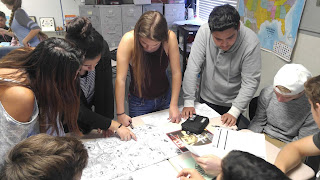

I use the games in my class for both review at the end of a unit and for content. For example, this past year, I used a Breakout game to teach my students about Watergate. I had limited time to cover the topic and found that rather than a lecture or worksheet (which I almost never do in my classroom anyway), I would find an engaging way to help them learn about the scandal.
I typically break students into four groups (I have 4 complete kits) to ensure there is a role for every student. I have an average of 34 students per class. Some games are completely physical games (with all clues in class). Others include online puzzles. I continue to refine and learn what works and doesn't work.
I have found that many of my students who may not do well on tests or on other assignments, excel in Breakout games. I had one student last year who was often in a group that failed to breakout. She was frustrated but refused to give up. Learning as we played each game, she came in the day of the Watergate Breakout and was determined. This time she and her group were not only the first to finish in her class, but out of all of my classes. The pride she and her team had was so cool to see.
I encourage you to give it a try! Your students will love it! Check out Breakout Edu to get started.

My games are centered around an entire unit such as the Gilded Age or a single topic such as Watergate. Students use their content knowledge to help them solve puzzles!

Breakout games promote the 4 Cs: Collaboration, Communication, Critical Thinking and Creativity!

Every team that completes the game in 45 minutes gets a photo. In the future, I will make a wall of fame with these pictures for the year. Students love to compete to see who has the fastest time!
Sunday, May 18, 2014
Getting Creative With National Monuments & Sites
The worst thing that can happen to a teacher is when they go through the unit too quickly and have days left to fill....or is it? Having to find something to fill three days out of the next 14 forced me to be creative. Thanks to Teach Like a Pirate by Dave Burgess, I started asking questions about how I could make a fun activity related to the unit, but not just give students busy work or a lecture. Our current unit is on the environment and energy, so I started out thinking about national parks. But, I soon realized that my unit was becoming to much of a science lesson (at least according to my students in AP Environmental) so I searched for inspiration. I found it on a list of national parks that also included national monuments and historic sites. That is where I realized that the national park service is US history content and what started as a decision to preserve the environment by Theodore Roosevelt has now become a way to preserve American history too. With that said, my students will be spending tomorrow researching a monument or site and then creating a marketing brochure to present to other students. For my students it will be enrichment to the curriculum and a way to keep them engaged as the school year winds down. Here is the link to my Weebly site with instructions! Pictures will follow once the activity is completed.
Tuesday, April 22, 2014
Lesson Hook: Simulating a Bus in Alabama, 1955
At Dave Burgess's "Teach Like a Pirate" seminar, I learned the importance of hooking the students into a lesson and have been searching for ideas ever since.
My lesson on the Montgomery Bus Boycott provided the perfect opportunity. I took a deck of cards and made sure to have the appropriate number of cards for my class period, ensuring that there was just a small amount of face cards. As students entered the room, each one was given a card. Once everyone was seated, I had everyone to stand up around the room. As I called a card, starting with Ace, the students who held that card were allowed to choose any seat in the room. This continued through the numbered cards. Once all of them were seated, those with face cards were told they could choose any seat they wanted, as long as it was a seat that was already occupied. Those "displaced" students then took the remaining open seats. Some got up quietly, others protested.
We proceeded to have a discussion as I first asked the "displaced" students how they felt, and then those with face cards responded. It was the perfect introduction to the bus boycott and allowed me to mix up the table groups for the day's activity, a DBQ answering the question, "Why did the Montgomery Bus Boycott Succeed?" I will be actively planning more hooks like this for my lessons.
My lesson on the Montgomery Bus Boycott provided the perfect opportunity. I took a deck of cards and made sure to have the appropriate number of cards for my class period, ensuring that there was just a small amount of face cards. As students entered the room, each one was given a card. Once everyone was seated, I had everyone to stand up around the room. As I called a card, starting with Ace, the students who held that card were allowed to choose any seat in the room. This continued through the numbered cards. Once all of them were seated, those with face cards were told they could choose any seat they wanted, as long as it was a seat that was already occupied. Those "displaced" students then took the remaining open seats. Some got up quietly, others protested.
We proceeded to have a discussion as I first asked the "displaced" students how they felt, and then those with face cards responded. It was the perfect introduction to the bus boycott and allowed me to mix up the table groups for the day's activity, a DBQ answering the question, "Why did the Montgomery Bus Boycott Succeed?" I will be actively planning more hooks like this for my lessons.
Tuesday, March 18, 2014
Hippies for a Day
 Thanks to Dave Burgess and #tlap, I have added a new element to my teaching - dress up days! I don't know why I never thought about having Decade Days before now! It is so easy to select a day to focus on the attire, music, art, culture, etc of a decade.
Friday was a minimum day so I made it our Counterculture Day. Students were asked to dress in tie dye or like hippies. We listened to the music of Bob Dylan, Janis Joplin, Country Joe and the Fish and Credence Clearwater Revival. Students were shown pictures and we also had a class debate on the draft after reading a couple of articles on the topic the previous day.
Next time I do this day, I want to add an activity to get students up and moving around. Because it was only a 40 minute class I felt rushed. Here are some pictures from the day:
.jpg)
Poster DBQs
Today is block schedule at my school which means 2 hour and 2 minute classes. That is a very long time for students to sit and listen to a lecture. We started off with our March Madness Elite 8 round and voting, but that only took 20 minutes. The idea for a visual DBQ came from an AVID conference that I had attended years ago.
I found 17 different documents (speeches, letters, diagrams, photos, etc) and put them together in a Google Doc. Students were put into groups of four and given the instructions to look through each document and decide how they would answer the question: Why did the US lose the Vietnam War? Once they had decided on an answer, they were given a piece of flip chart paper, scissors, markers and glue sticks. On the poster they had to write a thesis statement. Then students selected 6-8 documents that supported their claim as to why we lost the war. Each document was cut out and glued on the paper. Students wrote sentences underneath explaining how that document answered the question. Many students also chose to make colorful borders and pictures to enhance the look of their posters.
Each team was asked to present its thesis and supporting evidence. We then discussed comparisons to other wars, both past and present.
Rather than me telling them in 5 minutes the reasons why the US lost the war, students used document analysis, critical thinking and collaboration skills to answer the question. This took over an hour of group work. All of these skills are essential common core and 21st century skills. It also allows the students to take ownership of their learning rather than be passive listeners to a teacher on stage.
Here are some pictures of completed posters:


I found 17 different documents (speeches, letters, diagrams, photos, etc) and put them together in a Google Doc. Students were put into groups of four and given the instructions to look through each document and decide how they would answer the question: Why did the US lose the Vietnam War? Once they had decided on an answer, they were given a piece of flip chart paper, scissors, markers and glue sticks. On the poster they had to write a thesis statement. Then students selected 6-8 documents that supported their claim as to why we lost the war. Each document was cut out and glued on the paper. Students wrote sentences underneath explaining how that document answered the question. Many students also chose to make colorful borders and pictures to enhance the look of their posters.
Each team was asked to present its thesis and supporting evidence. We then discussed comparisons to other wars, both past and present.
Rather than me telling them in 5 minutes the reasons why the US lost the war, students used document analysis, critical thinking and collaboration skills to answer the question. This took over an hour of group work. All of these skills are essential common core and 21st century skills. It also allows the students to take ownership of their learning rather than be passive listeners to a teacher on stage.
Here are some pictures of completed posters:
Thursday, March 6, 2014
1950s Day
Yesterday was Fifties Day in my classroom. I went to Party City where I was able to get some decorations including a wall poster. I also used pictures from the decade around the room. Using Pandora Radio, I had fifties music playing while students entered the classroom. I let several songs play before beginning the lesson. On each table was a graphic organizer with 1950s slang words on the back.

Together we read through an article called Take Me Back to the 1950s, which highlights major cultural events of the decade. I paused along the way to share photographs, short stories, video clips and even my dad's letterman sweater. The video clips I used were three commercials (Coca Cola, Ford and Kool Aid), Elvis Presley (the 1st Ed Sullivan appearance to show his swinging hips and a later Ed Sullivan appearance), the chocolate scene from I Love Lucy and a short clip of Leave it to Beaver. Students were asked to write down things in six boxes (social conformity, women, automobiles/suburbia, teen culture, consumerism and entertainment). I encouraged students to dress fifties style and I did have several students who did. For the last five minutes of our class period, I held a hula hoop contest since the hula hoop was first popular in the fifties.
.jpg)
It was definitely a fun way to make history more alive and my students are very excited about our upcoming hippie day as we study the Vietnam War.
Together we read through an article called Take Me Back to the 1950s, which highlights major cultural events of the decade. I paused along the way to share photographs, short stories, video clips and even my dad's letterman sweater. The video clips I used were three commercials (Coca Cola, Ford and Kool Aid), Elvis Presley (the 1st Ed Sullivan appearance to show his swinging hips and a later Ed Sullivan appearance), the chocolate scene from I Love Lucy and a short clip of Leave it to Beaver. Students were asked to write down things in six boxes (social conformity, women, automobiles/suburbia, teen culture, consumerism and entertainment). I encouraged students to dress fifties style and I did have several students who did. For the last five minutes of our class period, I held a hula hoop contest since the hula hoop was first popular in the fifties.
It was definitely a fun way to make history more alive and my students are very excited about our upcoming hippie day as we study the Vietnam War.
Monday, March 3, 2014
Truman Trial
For the past five years, I have been including a mock trial in my curriculum. For one week (or sometimes longer), my classroom is transformed into a courtroom in 1953. The defendant is former President Harry S. Truman and he is charged with war crimes and crimes against humanity for dropping the atomic bombs on Hiroshima and Nagasaki in 1945. Students assume the roles of lawyers, witnesses, judges, court reporters, and jurors. The assignment becomes tiered with lawyers and witnesses eligible to earn A grades, judges and court reporters B grades and jurors C grades. Due to increased interest in witness level roles, I have created several new witness roles this past year. Originally there were 14 total, but I now can include 21 total.
The trial takes between 5-7 days depending on the number of witnesses, preparedness of the lawyers and number of times lawyers need to take breaks to meet with their witnesses. We start on day one with opening statements from the lawyers and then move right into prosecution witnesses. The witnesses for the prosecution include Premier Joseph Stalin, President Dwight Eisenhower, Ambassador Joseph Grew, Scientist Leo Szilard and Japanese Cabinet Member Hitsasune Sakomizu. Once all witnesses for the prosecution have gone, then the defense presents its case. Witnesses for the defense include Prime Minister Winston Churchill, Scientist J. Robert Oppenheimer and Japanese Minister Shigenori Togo. The final day includes closing statements and then the jury deliberates and votes.Throughout the trial, lawyers are encouraged to present primary sources related to the trial as evidence. This includes photos, maps, letters, etc.
The final assignment for the trial is an essay where students are asked to evaluate President Truman's decision to drop the atomic bombs on Hiroshima and Nagasaki.
I take photos and video throughout the trial and make a video each year that I present to the next year's students as a teaser for the trial.
The trial takes between 5-7 days depending on the number of witnesses, preparedness of the lawyers and number of times lawyers need to take breaks to meet with their witnesses. We start on day one with opening statements from the lawyers and then move right into prosecution witnesses. The witnesses for the prosecution include Premier Joseph Stalin, President Dwight Eisenhower, Ambassador Joseph Grew, Scientist Leo Szilard and Japanese Cabinet Member Hitsasune Sakomizu. Once all witnesses for the prosecution have gone, then the defense presents its case. Witnesses for the defense include Prime Minister Winston Churchill, Scientist J. Robert Oppenheimer and Japanese Minister Shigenori Togo. The final day includes closing statements and then the jury deliberates and votes.Throughout the trial, lawyers are encouraged to present primary sources related to the trial as evidence. This includes photos, maps, letters, etc.
The final assignment for the trial is an essay where students are asked to evaluate President Truman's decision to drop the atomic bombs on Hiroshima and Nagasaki.
I take photos and video throughout the trial and make a video each year that I present to the next year's students as a teaser for the trial.
Tuesday, February 25, 2014
March Madness Cold War Style
I recently attended a seminar by Dave Burgess on how to Teach Like a Pirate. One of the ideas that was mentioned in this seminar was how to take sporting events and current issues and bring them into your classroom. The idea was presented about repurposing March Madness and that is exactly what I have done! My students are going to compete in regions to determine the most influential event of the the Cold War.
I started with 64 Cold War events and programs, grouped them into categories and created the tournament brackets. Students were then divided into four regions and are responsible for researching the 16 events in their region. Each student has two events to research in most classes due to my class sizes. They are working collaboratively using Google Docs to create summaries to share with the whole class and are also completing a paper with "talking points" that they can use while discussing/debating in each round.
To make their research easier, I have used a great program called Livebinders to store websites on all 64 events. If you haven't yet checked out Livebinders, visit my Cold War Binder to see how it can be used.
After their research is complete, regions will work together to choose which events make it to the Sweet 16 and then it will become a whole class discussion. Each round adds new tasks and regions will be making presentations, posters and promoting their events. I also plan on inviting in guests to question students in the Final Four and Championship rounds.
Here is the link to my Weebly site with the instructions and documents. After the activity is complete I will be sure to update!

I started with 64 Cold War events and programs, grouped them into categories and created the tournament brackets. Students were then divided into four regions and are responsible for researching the 16 events in their region. Each student has two events to research in most classes due to my class sizes. They are working collaboratively using Google Docs to create summaries to share with the whole class and are also completing a paper with "talking points" that they can use while discussing/debating in each round.
To make their research easier, I have used a great program called Livebinders to store websites on all 64 events. If you haven't yet checked out Livebinders, visit my Cold War Binder to see how it can be used.
After their research is complete, regions will work together to choose which events make it to the Sweet 16 and then it will become a whole class discussion. Each round adds new tasks and regions will be making presentations, posters and promoting their events. I also plan on inviting in guests to question students in the Final Four and Championship rounds.
Here is the link to my Weebly site with the instructions and documents. After the activity is complete I will be sure to update!
Friday, February 7, 2014
Teach Like a PIRATE
Do you have a lesson that you could sell tickets to? If students did not have to come to your class, would you be teaching to an empty classroom? These two questions were presented to me at a recent seminar by US History teacher and author Dave Burgess. Dave's book, Teach Like a Pirate, has become a highly recommended book in the educational world and there is even a Monday night chat on Twitter called #tlap. The focus of Teach Like a Pirate is student engagement. Pirate is an acronym that stands for Passion, Immersion, Rapport, Ask & Analyze, Transformation and Enthusiasm.
The strategies and ideas presented in Teach Like a Pirate help teachers of all subjects and grade levels become more creative and find new ways to engage their students in content. Since joining the Twitter Monday night chats and attending two of Dave's seminars, I have been working to add more creativity into my lessons. Thanks to inspiration of Teach Like a Pirate, I have turned my classroom into a 1920s Speakeasy, created a Cold War March Madness tournament and am planning a couple of Decade Days. My students are responding with increased enthusiasm as they are tired of the same old lectures, worksheets, document analysis of their educational careers. Students are not only engaged, but are thinking critically and are more likely to remember the content years from now.
The strategies and ideas presented in Teach Like a Pirate help teachers of all subjects and grade levels become more creative and find new ways to engage their students in content. Since joining the Twitter Monday night chats and attending two of Dave's seminars, I have been working to add more creativity into my lessons. Thanks to inspiration of Teach Like a Pirate, I have turned my classroom into a 1920s Speakeasy, created a Cold War March Madness tournament and am planning a couple of Decade Days. My students are responding with increased enthusiasm as they are tired of the same old lectures, worksheets, document analysis of their educational careers. Students are not only engaged, but are thinking critically and are more likely to remember the content years from now.
Thursday, December 5, 2013
Yesterday's Enemies: A Story About Pearl Harbor
On or around December 7th of each year, I like to take a detour from whatever I am teaching and share a story with my students. It is about two individuals, Richard Fiske and Zenji Abe, who were at Pearl Harbor that fateful day in 1941...on opposite sides of the war. The story comes from a book by Dorinda Nicholson called Pearl Harbor Warriors.
Richard Fiske was a bugler on the USS West Virginia on December 7, 1941. He was on the deck of the ship when the Japanese planes arrived at Pearl Harbor. Before having to abandon ship, Richard saw the face of a Japanese pilot. For years he woke up with nightmares of that face. After ending up in the hospital with ulcers, his doctor told him it was time to let go of the anger that he felt. He and other veterans reached out to the Japanese to invite their veterans to the Pearl Harbor Anniversary festivities.
Zenji Abe was a Japanese pilot that had been at Pearl Harbor on December 7, 1941. He read about the invitation in a Japanese newspaper and came to the 50th anniversary in 1991. There he met Richard Fiske and the two became lifelong friends.
Every month, Zenji would send money to Richard to buy two roses. Richard would take those two roses and his bugle to the USS Arizona Memorial on the last Sunday of every month. He would play taps and place the two roses, one for the Americans and one for the Japanese. He did this every month until his death.
In the story, there is a quote from Richard that I always like to share with my students. He said, "Please remember that you don't have to hate forever.....you can say to your enemy. We fought each other. Okay. But today we are friends and let's build on that."
Richard Fiske was a bugler on the USS West Virginia on December 7, 1941. He was on the deck of the ship when the Japanese planes arrived at Pearl Harbor. Before having to abandon ship, Richard saw the face of a Japanese pilot. For years he woke up with nightmares of that face. After ending up in the hospital with ulcers, his doctor told him it was time to let go of the anger that he felt. He and other veterans reached out to the Japanese to invite their veterans to the Pearl Harbor Anniversary festivities.
Zenji Abe was a Japanese pilot that had been at Pearl Harbor on December 7, 1941. He read about the invitation in a Japanese newspaper and came to the 50th anniversary in 1991. There he met Richard Fiske and the two became lifelong friends.
Every month, Zenji would send money to Richard to buy two roses. Richard would take those two roses and his bugle to the USS Arizona Memorial on the last Sunday of every month. He would play taps and place the two roses, one for the Americans and one for the Japanese. He did this every month until his death.
In the story, there is a quote from Richard that I always like to share with my students. He said, "Please remember that you don't have to hate forever.....you can say to your enemy. We fought each other. Okay. But today we are friends and let's build on that."
Monday, December 2, 2013
Student Created Websites
As part of our studies on the Roaring 20s, I gave students a choice for a final project. They could choose almost any topic from the 1920s and had several options for the style of project including a children's book, museum exhibit, video or website. I certainly have some creative students and I am very impressed with the quality of projects. This post will highlight one of the types of projects, a website. I spent one day introducing Weebly to those students who wished to do a website and they found it easy and fun to collaborate for the finished project. Here are links to some of the best:
Thursday, November 21, 2013
Speakeasy Simulation: Bringing the 1920s to Life
On Halloween, I turned my classroom into a 1920s speakeasy to teach my students about Prohibition. I made sure students had a secret password the day before and as they entered my class, I asked them for it. It was fun to see students saying, "Joe sent me" and wondering why. I greeted them at the door, dressed as a flapper and asking for the password. As they entered my classroom, Charleston music was playing (courtesy of Pandora radio). I had a sign in front that said, "Welcome to the Haunted Speakeasy." On one table in the back were small cups of apple juice and Halloween candy. The room was decorated with pumpkins and orange lights. On the tables were black table cloths made out of butcher paper. And on the wall in the back were pictures from the 1920s. The first activity was for students to assume the roles of 17 different individuals associated with Prohibition. Their task was to circulate around the room and meet as many people as they could, each time finding out more and more about Prohibition.
I also gave students bonus participation points for dressing in period attire. Here are some of them:
I had one of the most enjoyable days of teaching in a long time and I heard my students talking about how much fun it had been. Even many of my most reluctant participants were up and talking to others and getting into the lesson. My brain is already spinning with ideas. Maybe a 1950s sock hop or a Vietnam War Sit In?
The first activity was for students to assume the roles of 17 different individuals associated with Prohibition. Their task was to circulate around the room and meet as many people as they could, each time finding out more and more about Prohibition. I also gave students bonus participation points for dressing in period attire. Here are some of them:
I had one of the most enjoyable days of teaching in a long time and I heard my students talking about how much fun it had been. Even many of my most reluctant participants were up and talking to others and getting into the lesson. My brain is already spinning with ideas. Maybe a 1950s sock hop or a Vietnam War Sit In?
Subscribe to:
Posts (Atom)